Leaps and bounds and bows.

I managed to capture a couple of milestones on video this week. More later!

First, another example of the ’emotional blunting’ I mentioned in my last post.

Amanda was watching an episode of ‘Offspring’ –  familiar to Kiwi and Australian viewers. A mother was giving birth to a stillborn baby. All the actors were in tears as the emotional scene dragged on. Amanda was watching intently as always. At the end I asked her if she had found the episode upsetting; such things would normally elicit a sniff if not a tear on the cheek. But this time…nothing. She just turned to me and smiled. ” It’s not real.” she said and carried on watching.


Each morning I still stand in the bathroom as Amanda takes her shower. In 4 months she has felt mildy dizzy while in there just twice and never slipped or fallen. I’m probably there for my peace of mind more than anything else and she still occasionally forgets her step by step procedure.

Once she is out it’s dressing gown on and off to get dressed. But on Wednesday something changed. She tied the bow on her dressing gown cord on her own; another positive sign she is getting more control of her right hand and arm. I filmed her this afternoon, just to show she can do it ‘on command’.


Saturday was Election Day in New Zealand. Our Polling Station is the local school. As the weather was fine we decided to walk. Amanda chose not to use her stick and instead held my hand for the walk there and back. This method speeds her up and improves her gait. The round trip was 3.5km which she managed easily… then slept for 2 hours!

On Sunday afternoon we went for another extended and stick – free walk. This time I filmed her so she could see for herself how much she has improved. We cannot work out if it’s the time or the distance, but these longer walks are giving her some feeling in her right leg. She can only describe it as ‘weird’ but i think it’s another example of, if you repeat somthing for long enough, whether it’s mental or physical, it seems to help the brain to reconnect with the disconnected body part.


” It’s been a good week.”

This week has been a busy mix of mental and physical improvements.

Monday

We now have a regular weekly visit from the language therapist who sits with Amanda for an hour each Monday morning and helps with the (for me) mystifying and frustrating effects of aphasia. Slowly but surely she is re-learning to write, spell and put names to colours, shapes and the symbols we know as letters and numbers. This is improving and getting to the point where some things are now automatic.

Tuesday

We have been given the chance for a number of sessions with a neuropsychologist. On the basis of taking every opportunity offered, we accepted the chance to have an expert assessment of where Amanda’s brain currently is and potentially where it might end up. This initial consultation was only for 40 minutes; as much concentrated questioning as she can manage at this stage. The psychologist mentioned something called emotional blunting

Amanda seems to have the ‘positive’ version of this. The phrase she often uses to explain her situation is ‘go with the flow’. If you know her, you’ll know she is one of the most laid-back, unfazeable and relaxed people you could meet. This trait has clearly helped her cope with the stroke and has been even further accentuated. The neuropsychologist likened it to ‘sandpapering off the edges of emotions‘. Since her stroke we have laughed far more than we have been upset by it, and not once have I seen Amanda express any negative emotion, anger, frustration or self-pity about her situation.

In fact her relentless positivity seems to be a continuation of her brain’s ongoing recovery towards adult maturity. You might remember, on admission to Nelson Hospital her mental capacity at that point was likened to that of an 18 month old. I joked a few weeks ago she must be around 12 years old by now. Then I remembered, and found her school report from February 1979; a week after she turned 15.

Amanda school report 001
She sparkles happily about the school entirely in tune with everything

Her form tutor wrote ‘She sparkles happily about the school entirely in tune with everything.’ While Mr Morgan may have been smoking weed when he wrote this, he accurately summed up her demeanour then, and it seems to fit quite well now as well.

Wednesday

Another visit from Jason the physiotherapist who is pleased with the progress Amanda continues to make. Practicing with squeezing a laundry peg is paying off as she can now successfully zip her jacket.

Friday

Today was the second visit to work; this time with the occupational therapist on hand to ensure she was being given suitable tasks, which she was. Her two hours stretched to two hours thirty as so many people were keen to see her again, some of them in tears apparently.

On Friday afternoon we also had new handrails fitted to the back steps. This means Amanda can now safely make her own way into the garden just as spring starts to warm it up again.

homework

On Saturday Amanda had her hair done by the lovely Jo At Serenity.

Another step towards normality.

Sunday

Another trip to the hydrotherapy pool for some gentle jogging, arm movements and even some holding the bar and kicking!

Amanda realised the language therapist is back tomorrow and asked me to check what her homework was. She hadn’t yet written her name and address without copying. But she manged this homework easily.. at 8 o’clock on Sunday night.

Typical teenager…

rail

“It’s been a good week.” She said.

“I feel like a functioning member of society again.”

For the first few weeks Amanda recommenced eating food from a plate instead of through her nose, she had severe right – side neglect. Basically her brain had forgotten she even had a right side. The occupational therapist taught her the trick of rotating her plate, so all her food would eventually come into view.

This improved by the time she got back home three months later. But she still has very little use of her right hand. So I make meals which can easily be eaten with just the left one.

In the last couple of weeks her food – consumption speed has sped up to the point where she sometimes finishes before two -handed me.

She does most things slowly. Walking, dressing showering etc. I asked her the other day if she felt ‘slow’ or if she felt as if she was going at ‘normal’ speed? She said it felt normal.

So, after a brain reboot and being away from work and society in general for over 7 months, I wonder if she has actually reverted to the speed we should all be going at?

We often hear about the speed at which modern society operates. There are pressures everywhere to meet deadlines. New inventions or iterations of existing appliances are always proudly touted as being faster than the previous version. Speed dictates how we live our lives and we all play along… unless our bodies decide otherwise.

I asked for comments on the Facebook groups I’ve discovered which support people recovering from stroke, and aphasia sufferers. It seems people generally take life more slowly, in the first 18 months after a stroke.

On Friday, Amanda spent her first few hours back at work, at the suggestion of her manager. The idea was to just sit at her desk and re-absorb the general office vibe and see what memories came back. A planned hour turned into 2 and she managed some simple filing and a few things came back to her. Hopefully this is a tentative first step of many…

In the evening we went out for dinner to celebrate our 33rd wedding anniversary. The restaurant was perfect; small, quiet and no background music so we could talk at a normal level. Nothing to distract or overwhelm a still – healing brain.

After a busy few hours back in the office, a good nap and a French meal, she looked around the room and said;

“I feel like a functioning member of society again.”


Routine is so important. So is sub routine.

IMG_20170903_121427There are so many similarities in Amanda’s situation and recovery to the way a computer works.

The brain bleed was like a piece of badly – written code; corrupting existing data and stopping the program from working correctly –  stopping it from executing existing code, saving information and subsequently retrieving it.

But somehow, luckily in all the chaos and uncontrolled trauma her brain, most likely assisted by the early intervention of the paramedics, managed to save a backup somewhere else.

At some point a few hours after her initial bleed, her brain initiated a ‘reboot’ –  and started to re-install the saved data. But instead of using the operating system she previously had –  Windows 10, her brain was now running on an old saved copy of Windows 95 –  on dial up.

Over the last 7 months Amanda’s brain has been slowly and steadily reinstalling, recompiling and downloading new versions of the data and information she has spent the previous 53 years using to run her life.

On some occasions she has gone straight to the latest software version ( language, vocabulary, grammar etc).  In other instances she is gradually working her way through old versions until her brain is ready to install a newer one. This applies both to physical capability and mental agility.

Thinking of stroke recovery like this helps to accept you don’t get the same person back. you get a different version depending on how much of the original programming gets reinstalled.

It’s like the story of the gardener who proudly boasts he’s had the same spade for 50 years. “I’ve only had to replace the handle four times and the blade twice.”

*************************************************************************************

Routines, repetition and sequencing are vitally important in re-enforcing everyday tasks; dressing, showering or making meals. Over the last few months Amanda has progressed by remembering routine and relying on her brain to recall what she used to do before the stroke.

The importance of this was demonstrated to me on Saturday.

Monday to Friday is an almost identical routine which helps to heal her brain. While weekends are slightly different (the times are different and the speed a bit more relaxed), the sequence of actions is generally the same.

But this Saturday was different.

Since last week’s visit to the local hydrotherapy pool was so successful we’ve decided to make it a regular event. 8.00am, before all the small kids start arriving for their weekly swimmimg lesson.

After 45 minutes of gentle bouyant exercise we were back home and decided to have breakfast before showering. Finally, as Amanda entered the shower she was back into her usual routine for the first time that day.

She washed her hair. Then…stopped. For a moment it was as if her brain had hit ‘pause’ and she stared at the blank wall of the shower.

“Now you wash” I prompted her as she looked at the various bottles.

“Pick up the shower soap, the white bottle and squeeze it on the sponge.”

…and she was back online.

I’d broken the routine. Altered the sequence of her usual morning ritual, and the program didn’t now what to do next.


We take our daily routine for granted. But we have it for a reason.

If something slightly different happens, it throws us off balance. An unexpected diversion on the drive to work, the first night in a strange bed or the sensation of new shoes. We all react in small, almost imperceptible ways to these small changes to our everyday lives and move on, often without even noticing.

But in the brains of stroke recoverers, these can be impossible to deal with…yet.

Mystery finally solved!

brain

Sunday 

Amanda spent an hour looking through her many recipe books. This is the first time she has shown any interest in these for 6 months. Her anomic aphasia (we are narrowing it down to a very specific type now), means she can read in her head, but not aloud, or paraphrase what she has just read. But the books held her concentration for an hour.

Monday

Amanda had her third MRI scan. The first was on the night of her stroke and the second three months later. At that stage her brain was still too traumatised for any cause to show up. This one, six months on, would hopefully show something significant.

Because an MRI is magnetic, not radiation -based, the technician allowed me to sit in the room. As Amanda slid into the large drum, her faced encased in a Star Wars – like mask and her head held firmly in a skull – shaped mould I watched as the lights on the front panel began to count down and scan her brain millimetre by millimetre. Despite ear plugs, I could clearly hear the multi million dollar machine as it whirred, whined and clicked loudly and rythmically.

She had no idea I was sitting there for 30 minutes, in a sealed room, filled with high tech medical equipment, on a cheap old wooden chair. I also resisted the temptation, as she was pulled out from inside the scanner to say;

“Congratulations. The experiment was successful. Welcome to 1975.”

Tuesday

Today was the 6-month check with the neurosurgeon in Wellington, so a lunchtime flight on a stunning early Spring day had us at the hospital in good time. The surgeon had barely had time to study the scan taken the previous day in any detail. But immediately he was almost certain he could finally see an arteriovenous malformation –  a tiny bundle of veins connected to an artery which should not be there. He quickly checked with a colleague who was also 99% certain.

Finally, after more than 6 months the mystery was almost certainly solved! This diagnosis also meant Amanda’s brain was now healed sufficiently for the AVM to be clearly visible.

Our son Joel, who also came to the appointment, decribed an AVM as like a small pool of slack water which sits on the side of a flowing river. The water in it eddys around and around and sometimes the rivebank breaks under the pressure.

The next steps, over the next few months are likely to be an angiogram to get better x ray images , and then a trip south, to Dunedin where they have the only Gamma Knife (sounds very ‘Marvel’) in New Zealand, to blast the AVM with a large pinpoint radiation dose to shrivel it away.

Wednesday

Amanda had used the hydrotherapy pool at Nelson Hospital. With only having a shower every day at home she hasn’t felt the benefit of being fully immersed in water for over 3 months. Luckily the local public pool also has a hydrotherapy pool.

We spent 45 minutes as she gradually regained her confidence and realised she could comfortably jog on the spot, and raise her affected arm a full 90° to her body, thanks to the bouyancy of the water. By the end of the session she was confident enough to hold on to the bar with both hands and let her legs float out behind her.

Thursday

Speech therapy continues in a sometimes Groundhog Day fashion as Amanda carefully remembers the letters S, N, R L & T and then looks at them blankly 10 seconds later. But the Tactus Therapy app on her Ipad seems to be working better as she is able to rearrange 7 or 8 letters into a word which matches a picture 100% of the time.

Friday

This morning the occupational therapist spent time noting Amanda’s daily routine and how she has progressed since being discharged 3 months ago. She offered Amanda a neuropsychological assessment so any gaps in her rehab can be identified and added.

In the afternoon, Amanda’s physiotherapist was pleased to note the improvement in the use of her right hand and the progress she has made in the past few weeks. Even he is getting into recording her progress for posterity and used her ipad to take the following video, so her carer can see how to help Amanda when she visits each day. Luckily I was able to easily find the Duplo bricks after hunting in the garage for Scrabble a few weeks ago.


Amanda’s quote of the week:

Me:- “What would you like on your crumpets –  Marmite, peanut butter, jam or lemon curd?”

Amanda:- “lemon curd please.”

Me:- “You know too much sweet stuff is bad for you?”

Amanda:- “Don’t buy it then.”

Spring is here, the grass is ris… I wonder where loyd Grossman is?

So, the 6 month ‘plateau’ has come and gone and progress continues.

Last week I downloaded the same ‘Tactus Therapy app used by Amanda’s speech therapist. This means she can practice her spelling and word recognition at any time. She spent an hour today browsing through her recipe books.

It’s not novel reading just yet, but its a start.

On the way to the Nelson Art Expo today I asked her to tell me each time we passed a red car and a blue car. She got them correct each time. Once we arrived at the art expo she was a little less discerning with her responses. As we walked past each artists’ display, a quick glance at their handiwork genetated the same swift critique; “nah, no, nope” 3 yesses out of around 1500 pieces of art. She knows what she likes art-wise.

But she did see several people she knew and remembered their names.

I took the photo below in the lobby of the art expo. The reason it’s important is the distance she is standing from any other object.  There is nothing within grabbing, leaning or reaching distance. Her balance and spatial awareness have arrived at the point where she obviously now feels comfortable ‘in space’. Another easily overlooked landmark.


IMG_20170820_120255
Not ‘lost in space’ Actually quite comfortable!

Amanda’s long – term memory is coming back in large chunks now. As she so eloquently put it;

“I didn’t lose my mind. I just forgot where it was.”

We woke this morning to bright sunshine and singing birds. While Spring doesn’t ‘officially’ start in New Zealand until September 1, today was quite spring -like.

“Spring is sprung the grass is ris, I wonder where the birdies is”

She recited as she got herself dressed.

Yesterday Amanda did something (can’t remember exactly what), and when I asked she said she had ‘ruminated and cogitated’ about it. It was a weirdly familiar phrase.

“Where did that come from?” I asked, vaguely remembering it was used in some kind of game show as the judges decided who the winner was.

“Masterchef” She immediately said.

Now, we’ve spent an hour, five nights a week, for the past three months, watching Australian Masterchef and I was pretty sure  Matt, George and Gary neither ruminated nor cogitated during the entire time.

But it still nagged at me, so I took a long shot and googled the phrase.

…and she was right.

The first version of Masterchef in the UK was presented by Loyd Grosman. It was his phrase. Masterchef 1990.

She remembered.

A stroke doesn’t always destroy memories. But it can push them overboard, try and drown them until they wash up on a deserted beach where they somehow survive while they dry out and are finally rescued by a passing neuron, on its way to discover a new, unchartered bit of brain, where the memory can be landed and remembered once again.

Glen, Dizzy and a rollercoaster week

On Thursday, Amanda baked a chocolate cake, assisted by her occupational therapist, carefully following the recipe on box (yes, it was a simple cake to start baking again). She had a hospital appointment (which was subsequently postponed) and wanted to take the cake into the ATR unit to give to the nurses who looked after her for 3 months.

We took the cake anyway and the nurses were very pleased to see her progress. Except… one called her name from behind and as she spun around her balance went. She didn’t fall but her inner ear kept ‘spinning’. She’d had dizzy moments three times before, just for a few seconds, but this once continued all evening and into the next morning.

According to Dr Google dizzy spells are common after a stroke. For the first morning since being home Amanda couldn’t face having a shower. This seemed like a set back. . I phoned the doctor at 8.15am and got an appointment for 9.30am. (rural New Zealand; sorry UK Health Service folks). The doctor gave her a thourough check and decided it was an inner ear issue and prescribed some anti nausea tablets which seem to be doing the trick.

……………………………………………………………………………………………………………………………………………………..

So this week Glen Campbell passed away and local TV played the 2014 documentary ‘I’ll Be Me’

This shows Glen as he performs his farewell tour having recently gone public with his Altzheimers diagnosis. We watched it together as he was shown forgetting names, words and showing the first signs of the disease to which he would eventually succumb 5 years later.

So much was eerily familiar. Altzheimers is a degenerative brain disease. A stroke on the other hand can be a regenerative brain injury. At some point in their progress they meet and mainifest in very similar ways. Luckily, those of us living with stroke can be reassured that the future is often positive; up, not down.

So, the up moment happened this morning, just 24 hours after the doctor’s visit.

Scrabble has been great (and previously mentioned) for helping with spelling and numeracy. So today I just used the tiles, Firstly jumbling them into simple 4 letter words and getting Amanda to put them in the correct order. Then building up to long words and hiding random letters in with the real ones. She got it.

When it was time to put them back in the green bag I asked Amanda to do it. She struggled until we realised the back of the tile has a small round indent, just big enough for a thumb. With practice, repetition and time (nearly 20 minutes) a hand which previously has been incapable of moving, lifted over 50 scrabble tiles, one by one, into the bag. I captured a moment of this feat on video for posterity and to remind us that stroke recovery is about perserverence, innovation, repetition and celebrating every small win.


Afterwards we went to the mall and Amanda celebrated with the largest hot chocolate I could find…

IMG_20170812_115246

Scrabble & dreams

img_20170806_191546.jpg
Great combination of literacy & numeracy! and yes, ‘QUOTE’ was Amanda’s word!

It’s been 6 months since Amanda’s stroke. Despite the so – called ‘plateau’ she is still making progress; progress she sometimes finds hard to see for herself. But even seeing her each day, I can see her doing things she simply could not do, even a month ago.

A while ago she mentioned she hasn’t dreamt since her stroke. She simply sleeps (very well for 8 hours a night plus an hour each afternoon), and wakes up. I haven’t researched this, but it doesn’t surprise me that brain injuries like this can have such a side effect. But last week she talked in her sleep.

Does that mean dreams have returned?

It doesn’t surprise me that a damaged brain needs all its ‘downtime’ to file and categorise the day’s events and doesn’t have the capacity to create dreams as well.

……………………………………………………………………………………………………………………………………………………..

The speech therapist suggested using Scrabble tiles to speed up word creation instead of spending half the time trying to remember how to write letters with the ‘wrong’ hand. She said I should take the letters from a word, and then jumble them on the table and let Amanda construct the word. But having the whole Scrabble set proved too tempting. Amanda was keen to give it a go, so we tried a game of full-on Scrabble.

Once I’d helped her find a word from her 7 letters plus those already on the board, I got her to verbally spell it; something she can do easily. Then I asked her to find those same letters and place them in the correct order on the board. Next I got her to add the value of each tile and take account of any double letter or word scores.

I split the game into 2 half-hour sessions during the day as I know this is all taking huge concentration. It’s facinating to watch as she gets quicker and hits a ‘sweet spot’ of performance after about 15 minutes. But then the concentration starts to wane and the simple arithmatic and word recognition gradually becomes completely alien again.

But this was just the first attempt at something I would not have considered a month ago.

We have left the game on the table to return to tomorrow.

Scrabble might just be one of the keys to further unlock those hidden memories…


Fixing curtains or a bullet to the brain. The outcome is the same.

I came across a video interview of US congresswoman Gabby Giffords. You might remember she was shot while campaigning in 2011. I can’t put the video on this site directly but you can watch by clicking here

As I watched I was struck by how  the bullet which struck her brain had left her with very similar issues to Amanda; aphasia, right -side weakness, vision problems and mobility challenges. In the interview she even wears the same splint Amanda  currently wears for 6 hours a day.

I had a look at Gabby’s Wikipedia page . Even her immediate treatment and the time line in the aftermath of the shooting bore a close resemblence to Amanda’s situation.

I’ve mentioned before that Amanda’s brain bleed was spontaneous and she had no risk factors and no underlying medical issues. She was discharged from hospital with no medication required and hasn’t had so much as an aspirin since.

In her case, the bleed has never been as a result of any ‘illness’. Like Gabby Giffords, she has been left with a brain injury. The same injury can be caused by a bullet, or car accident, or just reaching up to fix the curtains.

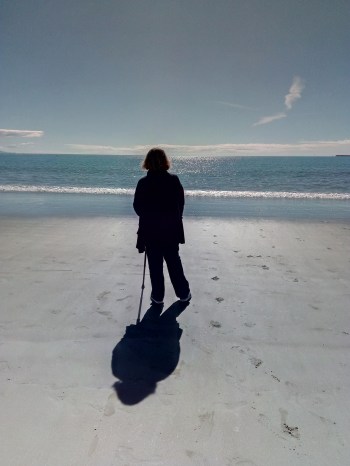
Today was a stunning winter’s day in Nelson. We went for a long walk on the beach. The sand was flat and perfect for enjoying the sunshine. As you can see, the beach was packed as usual…


That 6 month plateau is on the horizon…

On 2nd February, the day after Amanda’s stroke, the neurosurgeon  summarised her prognosis.

Looking back, he was gently introducing us to this whole new world using his wide experience to carefully make no promises, no assumptions, no guarantees.

Knowing where the bleed had caused the damage, he accurately predicted Amanda’s reading and writing difficulties and also prepared us for the possibility that her recovery might plateau around the 6 month mark.

That’s just a week away from now.

This week  we got a comprehensive report from the speech therapist who has been visiting for the past 3 weeks. This gives Amanda’s current situation the proper medical terminology, backs up the neurosurgeon’s accurate predictions from 6 months ago, and also endorses my own observations. There were no surprises, and it gives us a clear pathway to work on fixing the gaps in her brain which still make her call circles squares and yes, bananas are still more often than not blue!

The 6 month plateau is an easy trap to fall into. It’s the point where a level of routine and normality have set in at home. Acceptance of the situation is a dangerous comfort zone to stop and take a breather in and I would guess many people do just that. But with this new report, and the physio and occupational therapists booked in for weekly visits for a few months yet, there are new challenges still to overcome.

We might be on the plateau, but it gives us a clearer view of the road still ahead

………………………………………………………………………………………………………………………………………………..

I’ve joined a couple of Facebook groups which support people recovering from strokes. They are American – based as are most of the members. I’m struck by how the US health system allows people to recover and rehabilitate up to the point where they, or their medical insurance can no longer afford it.

So many people seem abandoned to the care and skill of their unprepared or unwilling family.

After 15 years of living in New Zealand this has been our biggest test of the free health system it provides. Much like the UK, care, equipment, medicine and expertise is free, and with the exception of having to pay for the initial ambulance, no expense has been spared, both in Amanda’s intensive care, ongoing care back in Nelson, and rehab now she is at home.

Her second trip to see the neurosurgeon in Wellington in a few weeks time, like the first, is paid for,  for both of us to fly over, with a taxi door-to-door at each end.

As people complain in the UK about the NHS, or in the US about their health system and even here in New Zealand with stories of cancelled operations and underfunded ICU’s, we have been extremely lucky with the quality and consistency of the service which initially saved Amanda’s life, got her back on her feet (literally) and continues to work to help her get back to where she wants to be.